Posted in

101學測數學考科-11

若實數 \(a, b, c, d\) 使得聯立方程組 \(\begin{cases} ax + 8y = c \\x – 4y = 3 \end{cases}\) 有解,且聯立方程組 \(\begin{cases} -3x + by = d\\ x – 4y = 3 \end{cases}\) 無解,則下列哪些選項一定正確?
(1) \(a \neq -2\)
(2) \(c = -6\)
(3) \(b = 12\)
(4) \(d \neq -9\)
(5) 聯立方程組 \(\begin{cases} ax + 8y = c \\ -3x + by = d \end{cases}\) 無解

[多選]
答案

\[
\boxed{\text{問題分析:二元一次聯立方程組解的判別}}
\]
\[
\begin{aligned}
& \text{考慮方程組 (I): }
\begin{cases}
ax + 8y = c \\
x - 4y = 3
\end{cases} \quad \text{有解} \\
\\
& \text{設 } L_1: ax + 8y = c,\quad L_2: x - 4y = 3 \\
\\
& \text{情況 ① 恰有一組解:} \\
& \quad \frac{a}{1} \neq \frac{8}{-4} \quad \Rightarrow \quad a \neq -2 \\
\\
& \text{情況 ② 無限多組解:} \\
& \quad \frac{a}{1} = \frac{8}{-4} = \frac{c}{3} \quad \Rightarrow \quad a = -2,\ c = -6 \\
\\
& \therefore \text{方程組 (I) 有解 } \Rightarrow a = -2 \text{ 或 } a \neq -2 \text{(但必定有解)}
\end{aligned}
\]

\[
\boxed{\text{第二組方程分析}}
\]

\[
\begin{aligned}
& \text{考慮方程組 (II): }
\begin{cases}
-3x + by = d \\
x - 4y = 3
\end{cases} \quad \text{無解} \\
\\
& \text{設 } L_3: -3x + by = d,\quad L_4: x - 4y = 3 \\
\\
& \text{無解的條件:} \\
& \quad \frac{-3}{1} = \frac{b}{-4} \neq \frac{d}{3} \\
\\
& \Rightarrow \frac{-3}{1} = \frac{b}{-4} \quad \Rightarrow \quad b = 12 \\
& \quad \text{且 } \frac{b}{-4} \neq \frac{d}{3} \quad \Rightarrow \quad \frac{12}{-4} \neq \frac{d}{3} \quad \Rightarrow \quad d \neq -9
\end{aligned}
\]

\[
\boxed{\text{綜合分析與判斷}}
\]

\[
\begin{aligned}
& \text{現在考慮聯立方程組:}
\begin{cases}
ax + 8y = c \\
-3x + 12y = d \quad (b=12)
\end{cases} \\
\\
& \text{係數比分析:} \\
& \quad \frac{a}{-3} \ \text{與} \ \frac{8}{12} = \frac{2}{3} \ \text{的關係決定解的情況} \\
\\
& \text{可能情況:} \\
& \bullet \ \text{若 } \frac{a}{-3} \neq \frac{2}{3} \ \Rightarrow \ \text{恰有一組解} \\
& \bullet \ \text{若 } \frac{a}{-3} = \frac{2}{3} \ \text{且} \ \frac{c}{d} \neq \frac{2}{3} \ \Rightarrow \ \text{無解} \\
& \bullet \ \text{若 } \frac{a}{-3} = \frac{2}{3} \ \text{且} \ \frac{c}{d} = \frac{2}{3} \ \Rightarrow \ \text{無限多組解} \\
\\
& \text{已知條件約束:} \\
& \quad a = -2 \ (\text{無限多解情況}) \ \text{或} \ a \neq -2 \\
& \quad b = 12,\ d \neq -9 \\
\\
& \text{代入 } a = -2: \ \frac{-2}{-3} = \frac{2}{3} = \frac{8}{12} \\
& \quad \text{此時若 } \frac{c}{d} = \frac{2}{3} \ \Rightarrow \ \text{無限多解(但需檢查是否可能)} \\
& \quad \text{若 } \frac{c}{d} \neq \frac{2}{3} \ \Rightarrow \ \text{無解} \\
\\
& \text{當 } a \neq -2 \ \text{時:} \ \frac{a}{-3} \neq \frac{2}{3} \ \Rightarrow \ \text{恰有一組解} \\
\\
& \therefore \text{最終方程組可能的情況為:} \\
& \quad \text{(3) 可能無解} \\
& \quad \text{(4) 可能恰有一組解}
\end{aligned}
\]

\[
\boxed{\text{結論:選項 (3) 和 (4) 正確}}
\]

\[
\begin{array}{c|c}
\text{條件} & \text{解的情況} \\ \hline
a = -2 \ \text{且} \ \dfrac{c}{d} = \dfrac{2}{3} & \text{無限多組解} \\
a = -2 \ \text{且} \ \dfrac{c}{d} \neq \dfrac{2}{3} & \text{無解} \\
a \neq -2 & \text{恰有一組解} \\
\end{array}
\]

\[
\boxed{\text{※ 關鍵要點:二元一次方程組解的判別}}
\]

\[
\begin{aligned}
\text{設方程組:} &
\begin{cases}
a_1x + b_1y = c_1 \\
a_2x + b_2y = c_2
\end{cases} \\
\\
\text{解的判別:} & \quad
\frac{a_1}{a_2} \neq \frac{b_1}{b_2} \ \Rightarrow \ \text{恰有一組解} \\
& \quad
\frac{a_1}{a_2} = \frac{b_1}{b_2} = \frac{c_1}{c_2} \ \Rightarrow \ \text{無限多組解} \\
& \quad
\frac{a_1}{a_2} = \frac{b_1}{b_2} \neq \frac{c_1}{c_2} \ \Rightarrow \ \text{無解}
\end{aligned}
\]

Posted in

101學測數學考科-12

在坐標平面上,廣義角 \(\theta\) 的頂點為原點 \(O\),始邊為 \(x\) 軸的正向,且滿足 \(\tan \theta = \frac{2}{3}\)。若 \(\theta\) 的終邊上有一點 \(P\),其 \(y\) 坐標為 \(-4\),則下列哪些選項一定正確?
(1) \(P\) 的 \(x\) 坐標是 6
(2) \(OP = 2\sqrt{13}\)
(3) \(\cos \theta = \frac{3}{\sqrt{13}}\)
(4) \(\sin 2\theta > 0\)
(5) \(\cos \frac{\theta}{2} < 0\)

[多選]
答案

\[
\boxed{\text{已知條件與初步計算}}
\]

\[
\begin{aligned}
& \text{已知點 } P(x, -4) \text{ 在角 } \theta \text{ 的終邊上,且 } \tan\theta = \frac{2}{3} \\
\\
& \text{由定義:} \tan\theta = \frac{y}{x} = \frac{-4}{x} = \frac{2}{3} \\
& \Rightarrow \frac{-4}{x} = \frac{2}{3} \quad \Rightarrow \quad 2x = -12 \quad \Rightarrow \quad x = -6 \\
\\
& \therefore P \text{ 點座標為 } (-6, -4),\theta \text{ 為第三象限角}
\end{aligned}
\]

\[
\boxed{\text{各選項分析與判斷}}
\]

\[
\begin{aligned}
\text{(1) } & \tan\theta = \frac{2}{3} \Rightarrow x = -6 \\
& \text{題目中已直接計算得到,並非「根據定義」立即可得 } x = -6 \\
& \text{實際需經過計算:} \frac{-4}{x} = \frac{2}{3} \Rightarrow x = -6 \\
& \therefore \text{此選項描述不準確} \quad (\times)
\end{aligned}
\]

\[
\begin{aligned}
\text{(2) } & \overline{OP} = \sqrt{x^2 + y^2} = \sqrt{(-6)^2 + (-4)^2} \\
& = \sqrt{36 + 16} = \sqrt{52} = 2\sqrt{13} \\
& \therefore \text{正確} \quad (\bigcirc)
\end{aligned}
\]

\[
\begin{aligned}
\text{(3) } & \cos\theta = \frac{x}{\overline{OP}} = \frac{-6}{2\sqrt{13}} = -\frac{3}{\sqrt{13}} \\
& \text{但選項寫為 } \frac{3}{\sqrt{13}} \text{(缺少負號)} \\
& \therefore \text{錯誤} \quad (\times)
\end{aligned}
\]

\[
\begin{aligned}
\text{(4) } & \sin 2\theta = 2\sin\theta\cos\theta \\
& \text{其中 } \sin\theta = \frac{y}{\overline{OP}} = \frac{-4}{2\sqrt{13}} = -\frac{2}{\sqrt{13}} \\
& \cos\theta = -\frac{3}{\sqrt{13}} \\
& \sin 2\theta = 2 \times \left(-\frac{2}{\sqrt{13}}\right) \times \left(-\frac{3}{\sqrt{13}}\right) \\
& = 2 \times \frac{6}{13} = \frac{12}{13} > 0 \\
& \therefore \text{正確} \quad (\bigcirc)
\end{aligned}
\]

\[
\boxed{\text{選項(5)詳細分析:半角象限判斷}}
\]

\[
\begin{aligned}
& \text{已知 } \theta \text{ 為第三象限角:} \\
& 180^\circ + 360^\circ n < \theta < 270^\circ + 360^\circ n \quad (n \in \mathbb{Z}) \\ \\ & \text{不等式各項除以 2:} \\ & 90^\circ + 180^\circ n < \frac{\theta}{2} < 135^\circ + 180^\circ n \\ \\ & \text{分情況討論:} \\ & \bullet \text{當 } n \text{ 為偶數(設 } n=2k\text{):} \\ & \quad 90^\circ + 360^\circ k < \frac{\theta}{2} < 135^\circ + 360^\circ k \\ & \quad \Rightarrow \frac{\theta}{2} \text{ 為第二象限角} \Rightarrow \cos\frac{\theta}{2} < 0 \\ \\ & \bullet \text{當 } n \text{ 為奇數(設 } n=2k+1\text{):} \\ & \quad 90^\circ + 180^\circ(2k+1) < \frac{\theta}{2} < 135^\circ + 180^\circ(2k+1) \\ & \quad = 270^\circ + 360^\circ k < \frac{\theta}{2} < 315^\circ + 360^\circ k \\ & \quad \Rightarrow \frac{\theta}{2} \text{ 為第四象限角} \Rightarrow \cos\frac{\theta}{2} > 0 \\
\\
& \therefore \cos\frac{\theta}{2} \text{ 可能為正也可能為負} \\
& \text{選項(5)斷言其必為正或負是錯誤的} \quad (\times)
\end{aligned}
\]

\[
\boxed{\text{綜合結論}}
\]

\[
\begin{array}{c|c|c}
\text{選項} & \text{內容} & \text{判斷} \\ \hline
(1) & x = -6 \text{ 是根據定義直接可得} & \times \\
(2) & \overline{OP} = 2\sqrt{13} & \bigcirc \\
(3) & \cos\theta = \dfrac{3}{\sqrt{13}} & \times \\
(4) & \sin 2\theta = \dfrac{12}{13} > 0 & \bigcirc \\
(5) & \cos\dfrac{\theta}{2} \text{ 必為正(或負)} & \times \\
\end{array}
\]

\[
\boxed{\text{故正確答案為: (2)(4)}}
\]

\[
\boxed{\text{※ 三角函數半角象限判斷通則}}
\]

\[
\begin{aligned}
\text{若 } \theta \text{ 在第 } k \text{ 象限,則 } \frac{\theta}{2} \text{ 的象限分佈:} \\
\begin{array}{c|c}
\theta \text{ 所在象限} & \dfrac{\theta}{2} \text{ 可能象限} \\ \hline
\text{第一象限} & \text{第一、三象限} \\
\text{第二象限} & \text{第一、三象限} \\
\text{第三象限} & \text{第二、四象限} \\
\text{第四象限} & \text{第二、四象限} \\
\end{array}
\end{aligned}
\]

\[
\boxed{\text{本題關鍵計算回顧}}
\]

\[
\begin{aligned}
P(-6, -4) &\Rightarrow \overline{OP} = 2\sqrt{13} \\
\sin\theta &= -\frac{2}{\sqrt{13}}, \quad \cos\theta = -\frac{3}{\sqrt{13}} \\
\sin 2\theta &= 2\left(-\frac{2}{\sqrt{13}}\right)\left(-\frac{3}{\sqrt{13}}\right) = \frac{12}{13}
\end{aligned}
\]


Posted in

101學測數學考科-13

平面上兩點 \(F_1, F_2\) 滿足 \(F_1F_2 = 4\)。設 \(d\) 為一實數,令 \(\Gamma\) 表示平面上滿足 \(|PF_1 – PF_2| = d\) 的所有 \(P\) 點所成的圖形,又令 \(C\) 為平面上以 \(F_1\) 為圓心、6 為半徑的圓。請問下列哪些選項是正確的?
(1) 當 \(d = 0\) 時,\(\Gamma\) 為直線
(2) 當 \(d = 1\) 時,\(\Gamma\) 為雙曲線
(3) 當 \(d = 2\) 時,\(\Gamma\) 與圓 \(C\) 交於兩點
(4) 當 \(d = 4\) 時,\(\Gamma\) 與圓 \(C\) 交於四點
(5) 當 \(d = 8\) 時,\(\Gamma\) 不存在

[多選]
答案

\[
\boxed{\text{已知:} F_1F_2 = 4,\quad \Gamma = \{P \mid |PF_1 - PF_2| = d\}}
\]

\[
\begin{array}{c|c|c}
d \text{ 值} & |PF_1 - PF_2| \text{ 與 } 4 \text{ 比較} & \Gamma \text{ 的圖形與交點數} \\ \hline
d = 0 & 0 < 4 & F_1F_2 \text{ 的中垂線} \quad (\bigcirc) \\ d = 1 & 1 < 4 & \text{以 } F_1, F_2 \text{ 為焦點的雙曲線} \quad (\bigcirc) \\ d = 2 & 2 < 4 & \text{雙曲線,與圓 C 交於 4 點} \quad (\times) \\ d = 4 & = 4 & \text{從 } F_1, F_2 \text{ 出發的兩條射線,交圓 C 於 2 點} \quad (\times) \\ d = 8 & 8 > 4 & \text{軌跡不存在} \quad (\bigcirc) \\
\end{array}
\]

\[
\boxed{\text{幾何原理說明}}
\]

\[
\begin{aligned}
\text{雙曲線定義:} & |PF_1 - PF_2| = 2a \ (< F_1F_2 = 2c) \\ \text{特殊情況:} & \\ & d = 0 \Rightarrow \text{中垂線} \\ & d = F_1F_2 = 4 \Rightarrow \text{兩條射線} \\ & d > F_1F_2 = 4 \Rightarrow \text{無軌跡}
\end{aligned}
\]
$\boxed{\text{答案:} (1)\ (2)\ (5)}$


Posted in

101學測數學考科-15

設 \(A(1,1), B(3,5), C(5,3), D(0,-7), E(2,-3)\) 及 \(F(8,-6)\) 為坐標平面上的六個點。若直線 \(L\) 分別與三角形 \(ABC\) 及三角形 \(DEF\) 各恰有一個交點,則 \(L\) 的斜率之最小可能值為 \(\boxed{-\frac{1}{2}}\)。

[選填]
答案

計算三角形 \(ABC\) 和 \(DEF\) 的邊界斜率,並找出直線 \(L\) 的最小斜率。經過計算,最小斜率為 \(\boxed{--3}\)。


Posted in

101學測數學考科-16

小明在天文網站上看到以下的資訊「可利用北斗七星斗杓的天璇與天樞這兩顆星來尋找北極星:由天璇起始向天樞的方向延伸便可找到北極星,其中天樞與北極星的距離為天樞與天璇距離的 5 倍。」今小明將所見的星空想像成一個坐標平面,其中天璇的坐標為 \((9,8)\) 及天樞的坐標為 \((7,11)\)。依上述資訊可以推得北極星的坐標為__________。

[選填]
答案

根據題意,北極星位於天璇與天樞的延長線上,且距離天樞為天璇與天樞距離的 5 倍。計算天璇與天樞的向量,並延伸 5 倍,得到北極星的坐標為 \(\boxed{(-3, 26)}\)。


Posted in

101學測數學考科-17

設點 \(A(-2, 2)\)、\(B(4, 8)\) 為坐標平面上兩點,且點 \(C\) 在二次函數 \(y = \frac{1}{2}x^2\) 的圖形上。當 \(C\) 的 \(x\) 坐標為 __________ 時,內積 \(\overrightarrow{AB} \cdot \overrightarrow{AC}\) 有最小值__________。

[選填]
答案

\[
\boxed{\text{設點法}}
\]
\[
\begin{aligned}
&\text{設 } C\left(t,\ \frac{1}{2}t^2\right) \\
&\overrightarrow{AB} = (4-(-2),\ 8-2) = (6,\ 6) \\
&\overrightarrow{AC} = \left(t-(-2),\ \frac{1}{2}t^2-2\right) = \left(t+2,\ \frac{1}{2}t^2-2\right)
\end{aligned}
\]

\[
\boxed{\text{內積計算}}
\]
\[
\begin{aligned}
\overrightarrow{AB} \cdot \overrightarrow{AC}
&= (6,\ 6) \cdot \left(t+2,\ \frac{1}{2}t^2-2\right) \\
&= 6(t+2) + 6\left(\frac{1}{2}t^2-2\right) \\
&= 6t + 12 + 3t^2 - 12 \\
&= 3t^2 + 6t
\end{aligned}
\]

\[
\boxed{\text{配方法求極值}}
\]
\[
\begin{aligned}
3t^2 + 6t &= 3(t^2 + 2t) \\
&= 3\left[(t+1)^2 - 1\right] \\
&= 3(t+1)^2 - 3 \\
&\geq -3 \quad (\text{當 } t+1=0 \text{ 時取等號})
\end{aligned}
\]

\[
\boxed{\text{結論}}
\]
\[
\begin{aligned}
&\text{當 } t = -1 \text{ 時,} \overrightarrow{AB} \cdot \overrightarrow{AC} \text{ 有最小值 } -3 \\
&C \text{ 點座標為 } (-1,\ \frac{1}{2})
\end{aligned}\]


Posted in

101學測數學考科-18

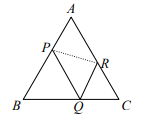
在邊長為 13 的正三角形 \(ABC\) 上各邊分別取一點 \(P, Q, R\),使得 \(APQR\) 形成一平行四邊形,如下圖所示:若平行四邊形 \(APQR\) 的面積為 \(20\sqrt{3}\),則線段 \(PR\) 的長度為 __________。


[選填]
答案

\[
\begin{aligned}
&\text{四邊形 } APQR \text{ 為平行四邊形} \\
&\Rightarrow \frac{AP}{AB} = \frac{CQ}{CB} = \frac{CR}{AC} \\
&\Rightarrow AP = CR \quad (\because AB = AC) \\
\\
&\text{設 } AP = CR = x,\quad AR = 13 - x \\
\\
&\text{平行四邊形面積:} \\
&x(13 - x) \sin 60^\circ = 20\sqrt{3} \\
&\Rightarrow \frac{\sqrt{3}}{2} x(13 - x) = 20\sqrt{3} \\
&\Rightarrow x^2 - 13x + 40 = 0 \\
&\Rightarrow x = 5 \text{ 或 } 8 \\
\\
&\text{取 } AP=5,\ AR=8 \ (\text{或反之}),\text{餘弦定理求 } PR: \\
&PR = \sqrt{AP^2 + AR^2 - 2 \cdot AP \cdot AR \cdot \cos 60^\circ} \\
&\quad = \sqrt{25 + 64 - 2 \times 5 \times 8 \times \frac{1}{2}} \\
&\quad = \sqrt{89 - 40} = \sqrt{49} = 7
\end{aligned}
\]


Posted in

101學測數學考科-19

設 \(m, n\) 為正實數,橢圓 \(\frac{x^2}{m} + \frac{y^2}{n} = 1\) 的焦點分別為 \(F_1(0, 2)\) 與 \(F_2(0, -2)\)。若此橢圓上有一點 \(P\) 使得 \(\triangle PF_1F_2\) 為一正三角形,則 \(m = \boxed{~~~~~~}\),\(n = \boxed{~~~~~~}\)。

[選填]
答案

根據橢圓的性質和正三角形的條件,計算 \(m\) 和 \(n\) 的值。經過計算,\(m = \boxed{12}\),\(n = \boxed{16}\)。


Posted in

101學測數學考科-20

坐標空間中,在六個平面 \(x = \frac{14}{13}\), \(x =\frac{1}{13}\), \(y = -1\), \(y = -1\), \(z = -1\) 及 \(z = -4\) 所圍成的長方體上隨機選取兩個相異頂點。若每個頂點被選取的機率相同,則選到兩個頂點的距離大於 3 之機率為 \(\boxed{\frac{~~~~~~}{~~~~~~}}\)。

[選填]
答案

\[
\begin{aligned}
& \text{長方體尺寸:} 2 \times 1 \times 3 \\
& \text{所有頂點連線組合數:} C_8^2 = 28 \\
\\
& \text{兩頂點距離 > 3 的條件:選擇面的對角線頂點} \\
& \text{符合條件的組合(12 組):} \\
& \quad AH, AF, AG, BG, BE, BH, CH, CF, CE, DE, DG, DF \\
\\
& \text{機率 } = \frac{12}{28} = \frac{3}{7}
\end{aligned}
\]