Posted in

106會考英語試題_31

[題組:第31到33題]
Cinema Times June 5th,2005
Thanks to globalization, we get to see movies from around the world. If anyone should feel most excited about globalization, it is US movie makers. A study in 2001 shows that, for every 100 people who go to the theater, 85 see US movies. This may be good news for US movie makers, but not for those in other countries.
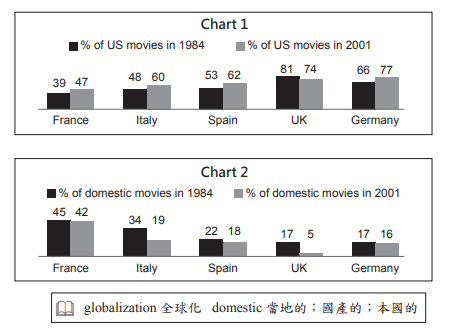
Chart 1 shows the percentages (%) of US movies in five countries in 1984 and in 2001; Chart 2 shows the percentages (%) of domestic movies in the five countries in 1984 and in 2001. In Chart 1, we can see that US movies have been popular in foreign markets. In Chart 2, we can see that domestic movies in the five countries are not doing well in their domestic market. The falling market for domestic movies may be a serious problem, but there is something more important. When people welcome US movies with open arms, they in fact also say yes to the American way of thinking. Some people in these countries worry that what is lost may not just be their domestic market for domestic movies, but also their own way of thinking that has been passed down from parents to children.
What does the report say about globalization’s influence on the movie world?

(A) It has changed the way of making movies.
(B) It has changed a country’s domestic market for movies.
(C) It has brought together movie makers from around the world.
(D) It has helped US movies make more money abroad than in the US.


[題組題]
答案
Posted in

106會考英語試題_32

[題組:第31到33題]
What can we learn from the report?
(A) The American way of thinking may be changed when it is brought to other countries.
(B) More and more people are asking their country to help their domestic movie business.
(C) US movies are popular in foreign markets because English is spoken in many countries.
(D) The fact that US movies are popular may mean the American way of thinking is popular.

[題組題]
答案
Posted in

106會考英語試題_33

[題組:第31到33題]
From the charts, which is true?
(A) The percentage (%) of US movies has changed the least in Spain.
(B) In each of the five countries, the percentage (%) of domestic movies has fallen.
(C) Of all five countries, UK’s domestic movies have the smallest drop in percentage (%).
(D) When the percentage (%) of domestic movies drops, the percentage of US movies rises.

[題組題]
答案
Posted in

106會考英語試題_38

[題組:第38到41題]
Englishman Robert Scott is known for leading two trips to Antarctica. The first one made him a star, the second __38___.
After his first successful trip, Scott decided to be the first person to stand on the South Pole. However, __39___. He would be in a race with Roald Amundsen, from Norway. Both left their countries by ship in June of 1910 and arrived in Antarctica in January of 1911.
About ten months later, both teams started their trips down to the South Pole. __40___. Amundsen’s team used dogs, and Scott’s team used horses. Because horses weren’t good at traveling on snow, it took Scott’s team 77 days to arrive at the South Pole. They got there on January 17, 1912, and were surprised to find that Amundsen was ahead of them. The news hit Scott very hard, but what he didn’t know was that __41___. His team began their long trip home with broken hearts. After days of terrible weather and little food, Scott lost his men one after another, and he himself was the last one to meet the end of his life. No one on his team lived to go back home and tell their story. It was only learned through Scott’s diary.

38.
(A) hurt his health
(B) opened his eyes
(C) cost him his life
(D) made his dream come true

[題組題]
答案