
Have you found a summer job yet? Mr. Firth ______ someone to take care of his kids during the vacation. Maybe you can talk to him.
(A) has looked for
(B) is looking for
(C) looks for
(D) was looking for
答案
Have you found a summer job yet? Mr. Firth ______ someone to take care of his kids during the vacation. Maybe you can talk to him.
(A) has looked for
(B) is looking for
(C) looks for
(D) was looking for
David looked out of the balcony window and saw a woman get in his car ______ away.
(A) drive
(B) drove
(C) and drive
(D) and drove
The police haven’t found the little girl who ______ at a supermarket. They’ll keep doing all they can to find her.
(A) took away
(B) taken away
(C) has taken away
(D) was taken away
Buses to the airport only come once every hour, and we just missed ______. Why don’t we take a taxi?
(A) another
(B) it
(C) one
(D) them
Ariel ______ every night for a week before her Chinese test and got a very good grade.
(A) studied
(B) studies
(C) has studied
(D) was going to study
While reading this story, Brad saw the word “trolling” and didn’t know what it meant.
Josh turned off the screen and sat back. “Why are they trolling me like this?” He didn’t understand. They wanted him to share what he thought about the show, and he did. And now look what he got. In the end, all they wanted was nice words.
He found several meanings of the word in a dictionary. Which one should Brad choose?
(A) To celebrate in song.
(B) To make someone or something move around.
(C) To pull a fishing line through the water, often from a boat.
(D) To write something on the Internet to hurt someone or make them angry.
【題組:第21題到第22題】
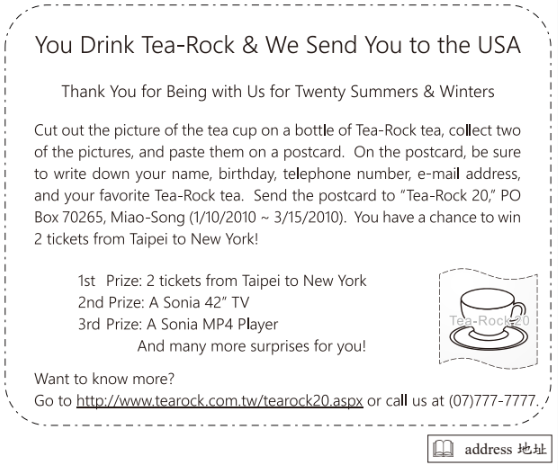
21. What does Tea-Rock celebrate?
(A) Their sales in 20 countries.
(B) The coming out of their 20th kind of tea.
(C) Their 20th year of business.
(D) The opening of their 20th store in the USA.
"" PO Box 70265
roomster
【題組:第21題到第22題】
Here is the postcard Jason is going to send to Tea-Rock 20. What else does he need to put on the postcard before he sends it?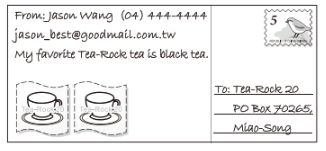
(A) His age.
(B) His address.
(C) His birthday.
(D) Another picture of the tea cup.
【題組:第23題到第24題】
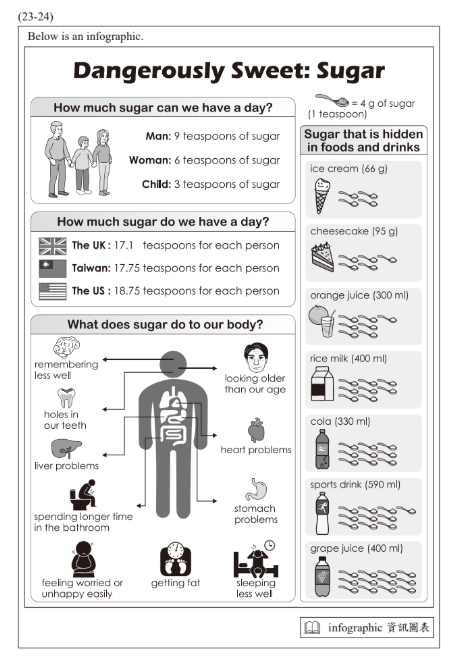
What can we learn about sugar from the infographic?
(A) There are 4g of sugar in 66g of ice cream.
(B) A woman can eat as much sugar a day as a man can.
(C) Taiwan eats more sugar for each person than the US does.
(D) 400ml of rice milk has less sugar than 400ml of grape juice.
【題組:第23題到第24題】
What can be a reason why the list of “Sugar that is hidden in foods and drinks” is put in the infographic?
(A) To help us understand how sugar hurts our body.
(B) To show what kinds of foods and drinks are popular with children.
(C) To tell us that we often have more sugar than we can without knowing it.
(D) To let us know how much sugar is enough to make foods and drinks taste good.