
【題組:第51題到第53題】
(2) What keeps a mosquito safe in the rain?
(A) It is very light.
(B) It has no body hairs.
(C) It is as big as a raindrop.
(D) It is strong enough to fight the force of a raindrop.
答案
【題組:第51題到第53題】
(2) What keeps a mosquito safe in the rain?
(A) It is very light.
(B) It has no body hairs.
(C) It is as big as a raindrop.
(D) It is strong enough to fight the force of a raindrop.
【題組:第51題到第53題】
(3) When would it be dangerous for a mosquito in the rain?
(A) When it flies too close to the ground.
(B) When the rain falls too hard and too fast.
(C) When it is hit by raindrops too many times.
(D) When it drops for more than 6 cm in the rain.
【題組:第54題到第56題】
You probably have heard Beethoven’s famous piano piece “For Elise,” but do you know who “Elise” was?
One story is that Elise was Elisabeth Röckel. She once sang in Beethoven’s opera Fidelio, and the two became very good friends. Beethoven called her “Elise.” When Röckel was leaving the city of Vienna, Beethoven wrote “For Elise” to say goodbye to her. Another story is that Elise was Therese Malfatti. Beethoven was in love with her. He wrote a piece for her and put “For Therese” on the manuscript. Malfatti kept the manuscript and left it to her family when she died. Later, a man copied the manuscript and wrote “For Elise” by mistake. There is another possible Elise: Elise Barensfeld. She learned the piano from Malfatti, the same Malfatti in the second story. To help Malfatti, Beethoven wrote the piece for her to use to teach Barensfeld.
These are just some guesses about who Elise was. We may never know the right answer. No one knew about the piece until 1867, when the manuscript was found. This was 40 years after Beethoven’s death, so he wasn’t around to tell us who Elise was. Only one thing is for sure: “For Elise” will always be enjoyed.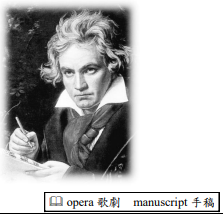
(1) What do the three stories in the reading all talk about?
(A) Who Beethoven’s true love was.
(B) Who played “For Elise” the best.
(C) How “For Elise” became popular.
(D) Why Beethoven wrote “For Elise.”
【題組:第54題到第56題】
(2) What do we know about “For Elise” from the reading?
(A) It first appeared in the opera Fidelio.
(B) The true “Elise” was Elise Barensfeld.
(C) The manuscript was found after Beethoven died.
(D) The manuscript is now kept by the city of Vienna.
【題組:第54題到第56題】
(3) What can we learn about the three women from the stories?
(A) They were called “Elise” by their friends.
(B) Elisabeth Röckel was a close friend of Beethoven’s.
(C) Therese Malfatti changed “For Elise” to “For Therese.”
(D) Elise Barensfeld was Beethoven’s student.
【題組:第57題到第59題】
Jesse Cohen Says
Family 365
July 2017
No, they are not children that love to buy toys online. It is just a common rule in many families: boys play with cars and balls, and girls play with dolls and cooking sets. Many parents follow this rule when choosing the right toys for their boys and girls.
However, this rule can be bad for children. Different toys teach children different things. Dolls help with their early language use, and building toys are good for learning math and science. If boys never play with dolls and girls never touch building toys, they may miss the chance to learn what they are interested in or good at. Some doctors worry that children may use the same kind of thinking when they look for jobs in the future. For example, they may think that teaching is only for women and that engineering is only for men. This kind of thinking stops them from trying different jobs and finding out what they really want to do.
(1) What idea does Jesse Cohen talk about in the reading?
(A) Not all kinds of toys are helpful for children’s learning.
(B) Parents should give their children the right toys for their age.
(C) Children should learn about their gender from playing with toys.
(D) We should not let gender decide which toys children can play with.
【題組:第57題到第59題】
(2) In the third paragraph, why does Jesse Cohen think “this rule can be bad for children”?
(A) Children may not want to share their toys with others.
(B) Children may have the wrong idea about following rules.
(C) Children may not be able to learn from playing with toys.
(D) Children may miss the chance to find out what they really like.
【題組:第57題到第59題】
(3) In the reading, after Jesse Cohen talks about an idea, he often gives an example to make it clear. Below are four of the sentences in the third paragraph. Which is used as an example?
(A)“However, this rule can be bad for children.”
(B)“Dolls help with their early language use, and building toys are good for learning math and science.”
(C)“Some doctors worry that children may use the same kind of thinking when they look for jobs in the future.”
(D)“If they do, they may miss something more important than just getting a chance to play with different toys.”
【題組:第60題到第62題】
Marie Colvin was a world-famous war reporter. She was born in New York, USA, in 1956 and died in Homs, Syria, in 2012.
When she was a student at Yale University, Colvin decided that she wanted to be a reporter in the future. She joined the Sunday Times, a UK newspaper, in 1985 and soon became its Middle East reporter. Besides the Middle East, she also reported from other parts of the world: Chechnya, Kosovo and Sri Lanka, for example. When she was reporting on the war in Sri Lanka, she lost her left eye. But that never stopped her. She still went to dangerous places that few reporters wanted to visit and stayed when others left.
Colvin showed great empathy in her stories. For her, war reporting was not just some quick interviews and a few photos. She wrote about real people and their real lives. Her writing made you feel so strongly about these people’s stories, just like they were your own. She hoped that through her work the world would understand what really happened in war, and would take action to stop the fighting.
On February 22, 2012, the day after she gave her report on the war in Homs, Colvin was killed when the house she was staying in was attacked. She always knew what price a war reporter might have to pay. She already lost an eye before. This time, she gave her life to the work she could not give up – telling the true stories to the world.
(1) What is the reading mostly about?
(A) Marie Colvin’s war reports.
(B) Marie Colvin’s working life.
(C) Marie Colvin’s schooldays at Yale.
(D) Marie Colvin’s experiences in Homs.
【題組:第60題到第62題】
(2) What does it mean when someone has empathy?
(A) They are good at taking war photos.
(B) They like to read other people’s life stories.
(C) They are able to understand how other people feel.
(D) They are good at helping people change their own lives.